Cindy Frenkel
Writer | Teacher | Editor
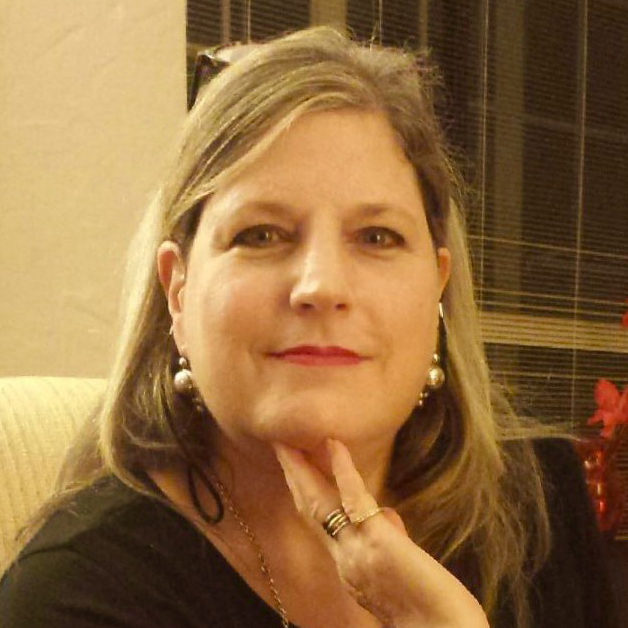
The Plague of the Tender-Hearted
Cindy's chapbook
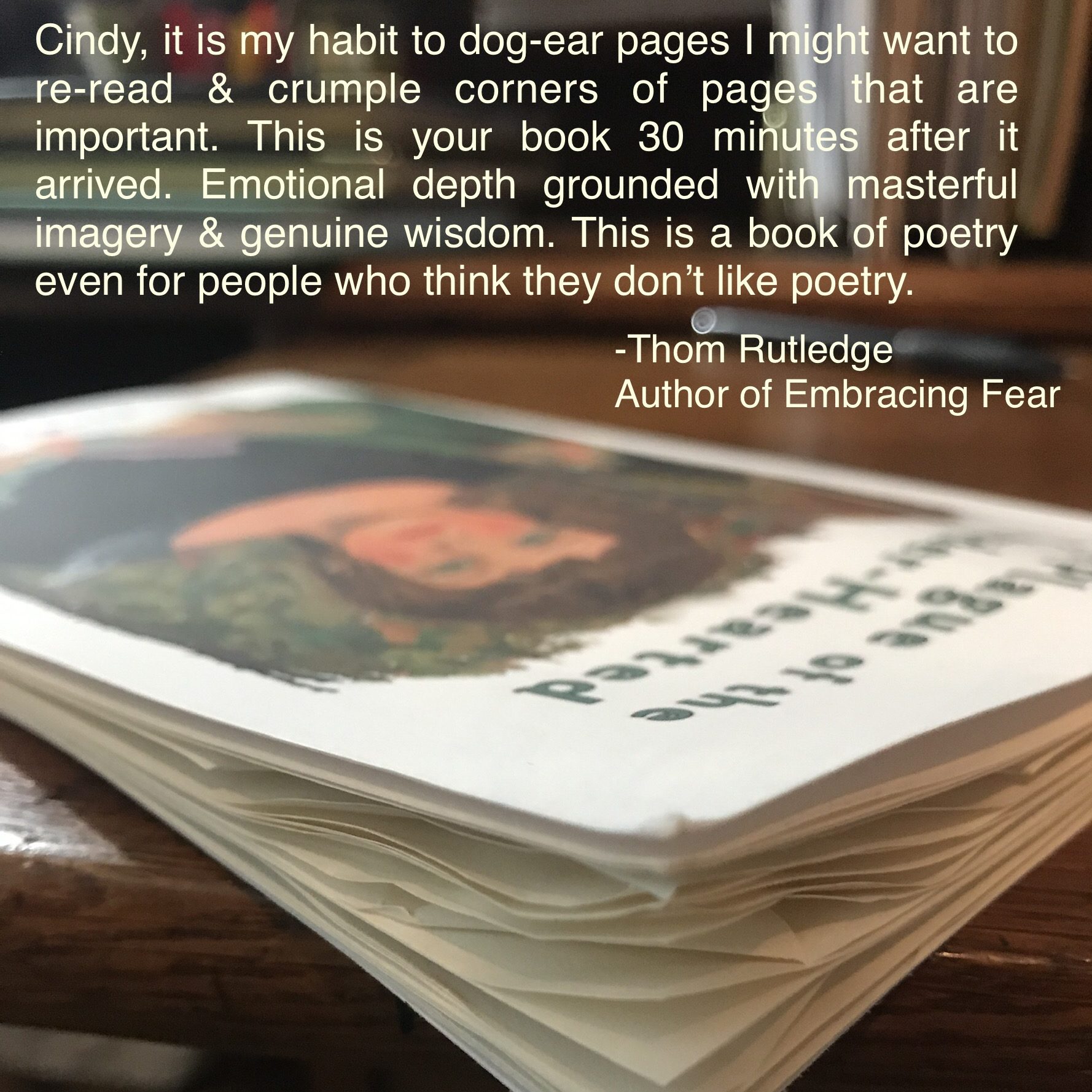
"With her three-part alchemy of plain speaking, suddenly perfect metaphors, and explosive, morally anchored last lines, Cindy Frenkel portrays a family in The Plague of the Tender-Hearted. From the witty to the elegiac, the poems quest for the why beneath a brother’s suicide and examine the underside of prosperity. But the marvels of this collection are the sassy buoyant poems of love for a daughter and unexpected love after divorce. Frenkel uses memory, the dynamics of aging parents, and the legacy of the Holocaust to pierce us with her bullseye poetic one-liners. The Plague of the Tender-Hearted, with its gem-like rhymes, is both an exploration and a revelation."
Molly Peacock
"The poems in Cindy Frenkel’s chapbook The Plague of the Tender-Hearted sear and delight. There are the brave, wrenching poems reanimating her beloved brother who took his own life. There are poems that sing with painful memory and even more painful love. There is the poignant poem spanning three generations of women, a trefoil of “roles reversed, everything askew.” Frenkel’s four-line “Elegy” is as powerful in its brevity as her "Anatomy of Color,” an ode to spring that unfurls over two pages. I cannot decide which I favor more, “This has been” or “Raising her is better than.” The former is a poem to her lover; the latter a love poem to her daughter. Fortunately, I don’t have to choose. The Plague of the Tender-Hearted will rest on my nightstand for quite a while."
Debra Darvick
"In The Plague of the Tender-Hearted, Cindy Frenkel makes her way through the maze of family death, divorce, and even a brother’s suicide without ever losing the ability to embrace joys small and large. Despite heart-rending troubles, there is still beauty in the natural world, the discovery of an unlikely new love, and moments with a beloved daughter when night 'stars spill out, / enough to occupy the universe.'"
Mary Jo Firth Gillett
Featured Work
Switching Gears: Less Teaching, More Writing
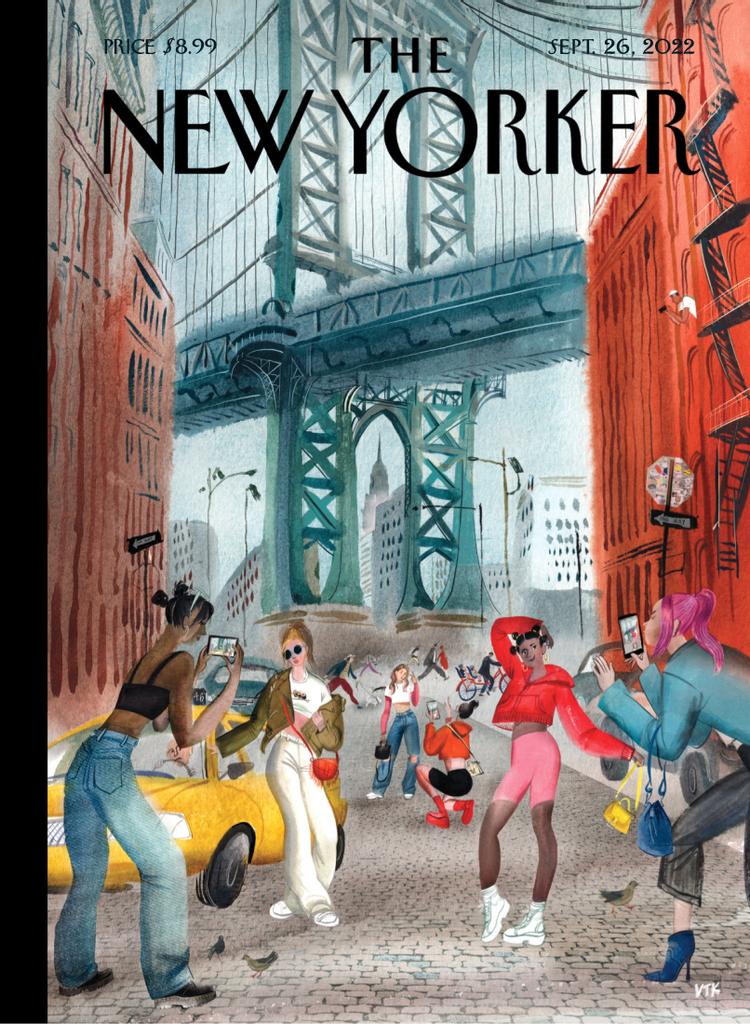
The New Yorker Magazine
Cindy's poem 'Pit' was published in the September 26, 2022 edition of The New Yorker.

Articles on Wired
"How to Set Healthy Boundaries Around What You Share Online"
“Teaching Classic Lit Helps Game Designers Make Better Stories”
About the class, Creative Writing for Video Gamers, she helped design with help from faculty at Lawrence Technological University.
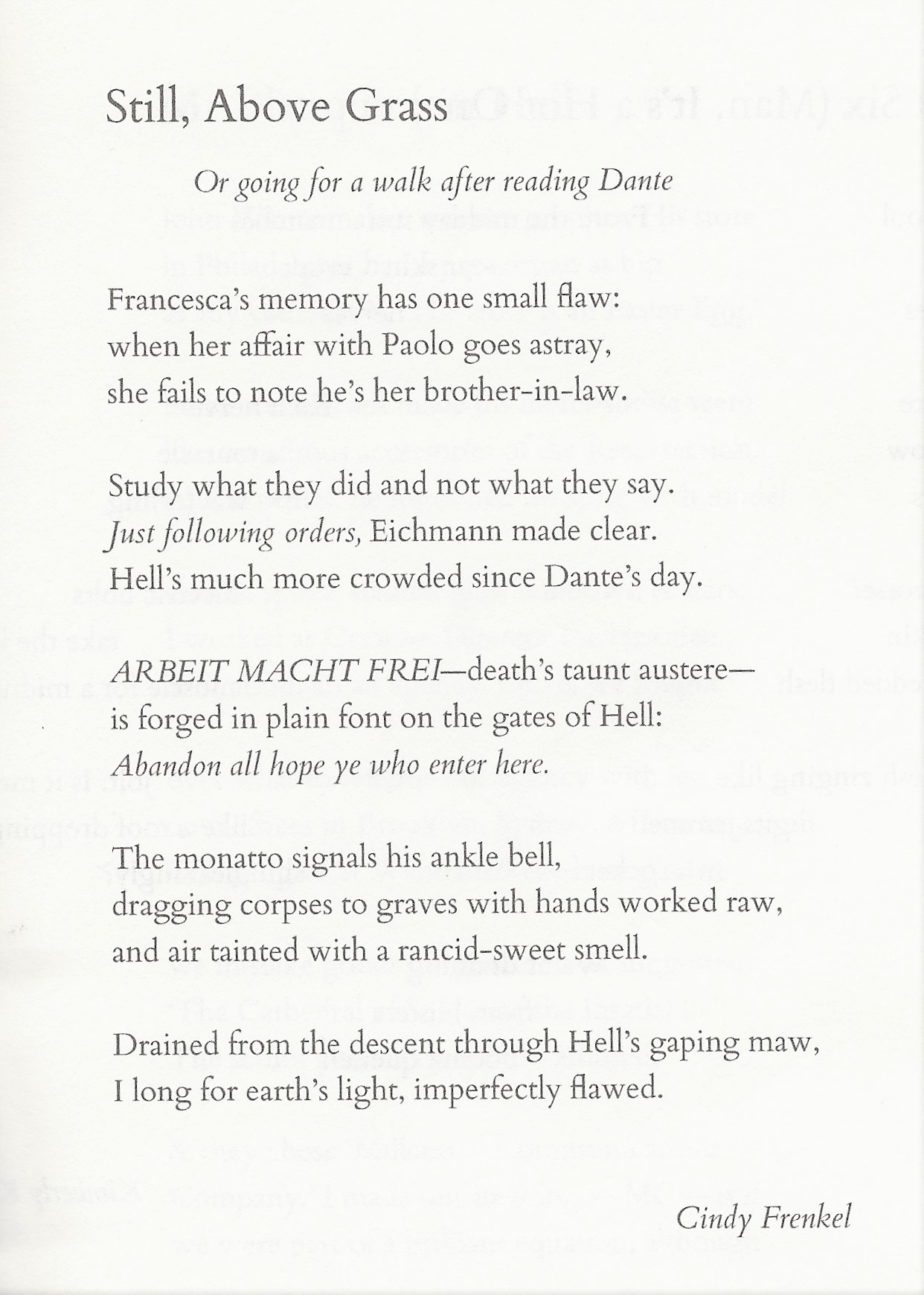
Divining Dante
Cindy's "Still, Above Grass" was one of 20 poems selected from Divining Dante, an anthology from Recent Work Press, to be included in The Poetry Jukebox, a European street art project, with poems for listeners to hear. Her recording will be up and running this winter, in time to celebrate the 701st anniversary of the great poet's death.
More Recent Work
Frenkel's first full-length poetry collection, over 100 pages, will be released this spring from Kelsay Books
I asked a kind man steeped in religion if he knew
the Jewish view on money. “More of it?” he joked,
not meaning to offend. It stung. “Who is rich?” our rabbis ask,
“He who is happy with what he has.”
I thought of Dallas, Lifestyles of the Rich and Famous,
our country’s chronic coveting, then of the Taj Mahal.
The slaves, we forget, encrusting it in jewels.
The pyramids. And what of them?
A convert taught me my religion’s views — money, a blessing,
if come by honestly then shared with others, something
that I wished I’d known. The poor, required still, to help those
less fortunate, unless one is too poor to give. No shame in that
yet not a good way to live. Tikkun Olam! Repair the world.
Leave it better than I found it. When I meet my maker,
how will I answer, “Have you welcomed every permitted pleasure?”
I warm my bath and now I step in.
While getting ready to go out of town, I'd been unintentionally abrupt to Deborah on the phone, so I called her back before bed once I was in Toronto, explaining my life was too full at the moment. I felt bad that I didn't have time for a new friendship.
We launched into a conversation that lasted well over an hour and a half (perhaps two and a half?). There I was, on a hotel bed, when I blurted out, "We have the bones for a really good friendship!" She said, "That's a really good line," and I realized we both liked it so much that I got up to write it down.
There wasn't one conversation with her when I didn't want to have another and now that sad longing will remain. I wish that I'd had her to my home, so she could peruse my environment, and I could have been to her apartment, to visit her in her element – to look at her books, the art on her wall, her balcony garden.
Our interests overlapped in huge ways, from our deep love of poetry to Israel to Detroit. We also felt the shock and despair not only of October 7th but that of October 8th with the same horrific gravity, so our world was made smaller. We remained stunned at the illogic of people who claimed to care about everyone but clearly bypassed Sharansky's 3Ds.
When I heard her read last fall at Kickstart Gallery in downtown Farmington, along with other local, wonderful poets for the launch of Jan Mordenski's Quadra-Project calendar, I couldn't get over Deborah's Kafka poem. I told her that I wanted to put together an anthology with her and Jan that would feature Michigan poets – the talent here needed more exposure! She was delighted. We spoke several other times and then ... suddenly, she was gone.
Here's what I most admired and will miss: her astute perceptions of the geo-political world-at-large – we were bouncing various names off each other because we didn't know all the other's references – her deep well of compassion, as well as her talent – so wide ranging: Yiddish! Classical piano. A self-taught poet ... The list goes on. Of course, all this was due to her insatiable curiosity coupled with a quick wit, which made her not only fascinating to talk with but also extremely fun.
was forbidden in Nazi Germany,
then brought them home: white pitcher with yellow
blooms striated pink, green arches droop their
acrobatics jauntily. In my straw
hat, I stroll on the sidewalk, move freely
towards my friends at the soft serve stand, where our
hair’s blowing in the wind — mine, white, one friend’s
black corkscrew curls, the other’s straight and blonde.
Silently, grateful, no need for ID
on my sleeve — my mother admonishes
still, You don’t want to live in Royal Oak!,
Father Coughlin’s words in her head.
She’s long dead. Yet here she lives. We support
the veteran, who trades paper poppies
in exchange. Sitting on a bench, the dense
shadows interrupt our light: three sprightly
forms mimic us, though it’s only we who
recognize our great good fortune now,
on this, an otherwise ordinary day.
Serving
In memory of Forsteen "Tina" Brooks
The Fisher Building still bustles
but in the sixties, we’d walk
into Himelhoch's, which is now only online,
sells Ethiopian coffee. When I was little,
we’d ride Hudson’s elevators, later
have a Maurice salad or go
to Sanders in Royal Oak, which was not
chic yet, for shaved ham sandwiches
and a hot fudge creampuff. We’d sit on stools
at the counter, my mother and I,
we were always served sitting on those stools—
though not too many years before, down south
the woman I loved among the most
couldn’t have sat with us.
I didn’t know why then.
Neither did I know most Jews didn’t eat
ham sandwiches—we didn’t have pork at home—
only crisp bacon, a staple, and never
ever wore a Jewish star around our necks.
Might as well wear an armband
with its yellow-pointed patch.
Those were the days when your pumps
matched your pocketbook,
that’s what we carried—not purses—
and ladies lunched, taking small bites
at others, keeping their lipstick clean.
Detroit, booming (and how I want it now),
youth, here, with options—
knowing every job has meaning, the need
for plumbers, phone operators, all the valued
salesladies, waiters and counter girls,
salesmen, electricians, mounted police
when cops walked their beats.
I salute all you men and women,
who staffed the elevators,
who showed up over and over,
so we could sit under bright lights
at a clean counter, eating shaved ham.
"The Art of Observance"
Cindy read poems that focused on delighting in the smallest detail: Seeing the world's marvel closely helps usher in joy. She also briefly read about the darker side, including suicide awareness and prevention. The reading was for Detroit's First Unitarian Universalist Church on April 28th, 2022.
Prose Related to Poetry
“Fifteen lessons from nine years of teaching" from Writing in Education, Issue Number 76, published overseas by the National Association of Writers in Education (NAWE).
“Sharing Voices, Acting Crazy“ (excerpted from the anthology To Light A Fire)
Galway Kinnell and the Blue Button-Down (from The Southampton Review)
Questions about how Cindy can help you? Drop Cindy a line to find out more!
Teaching, editing, writing, and more.